


RUSD budget reflects state cuts, falling enrollment
The 2025-26 budget shows steady reserves but projects deficit spending.

REDLANDS, Calif. — Redlands Unified School District (RUSD) is entering the new fiscal year with steady reserves, but the path ahead is less certain.
Why it matters: During the June 24 school board meeting, RUSD Director of Fiscal Services Kirtan Shah presented the district’s 2025–26 budget, which projects a year-end fund balance of $70.7 million, down from $91 million the previous year. Over the next three years, that balance is expected to shrink to $48 million due to declining enrollment and reductions in state funding.
Details: The most immediate concern, Shah said, is the state’s decision to defer $1.8 billion in education payments until July 2026, potentially complicating payroll for some smaller districts. Redlands, however, is large and stable enough to absorb the delay.
The state’s Prop 98 minimum funding guarantee, which is a key source of public school funding, is also $4.6 billion lower than anticipated. At the same time, the cost-of-living adjustment (COLA) for schools has been reduced to 2.3%, down from an initial 2.93%.
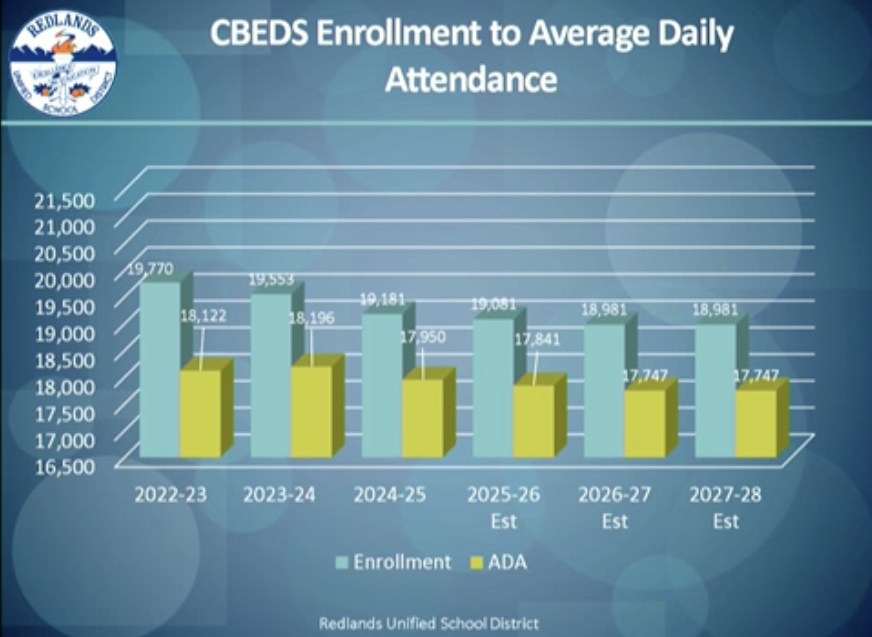
At the local level, RUSD continues to experience declining enrollment and attendance. The district lost 372 students in the 2024–2025 school year and expects to lose another 100 each of the next two years before stabilizing. As a result, funding tied to average daily attendance is also shrinking.
What’s more, fewer students are qualifying for free or reduced lunch or other services, known as “unduplicated pupils,” a metric that includes students from low-income families, English learners and foster youth. The drop in these numbers will reduce funding by roughly $1.6 million. Meanwhile, special education costs are expected to rise by $5 million.
What they’re saying: “We need more money,” Board of Trustees Vice President Patty Holohan said at the conclusion of the presentation.
Zoom out: School districts across California are facing similar challenges. The end of pandemic-era federal funding, coupled with a drop in student enrollment statewide, has put financial pressure on many districts, resulting in layoffs and program closures.
Moving forward: Despite these challenges, the district is still meeting its 3% reserve requirement, and no budget revision is expected this summer.
