REDLANDS, Calif. — Redlands Unified students have yet to regain the ground lost in English and math following the COVID-19 pandemic, with newly released state test results showing little improvement districtwide and the district falling behind California in math after outperforming the state before the pandemic.
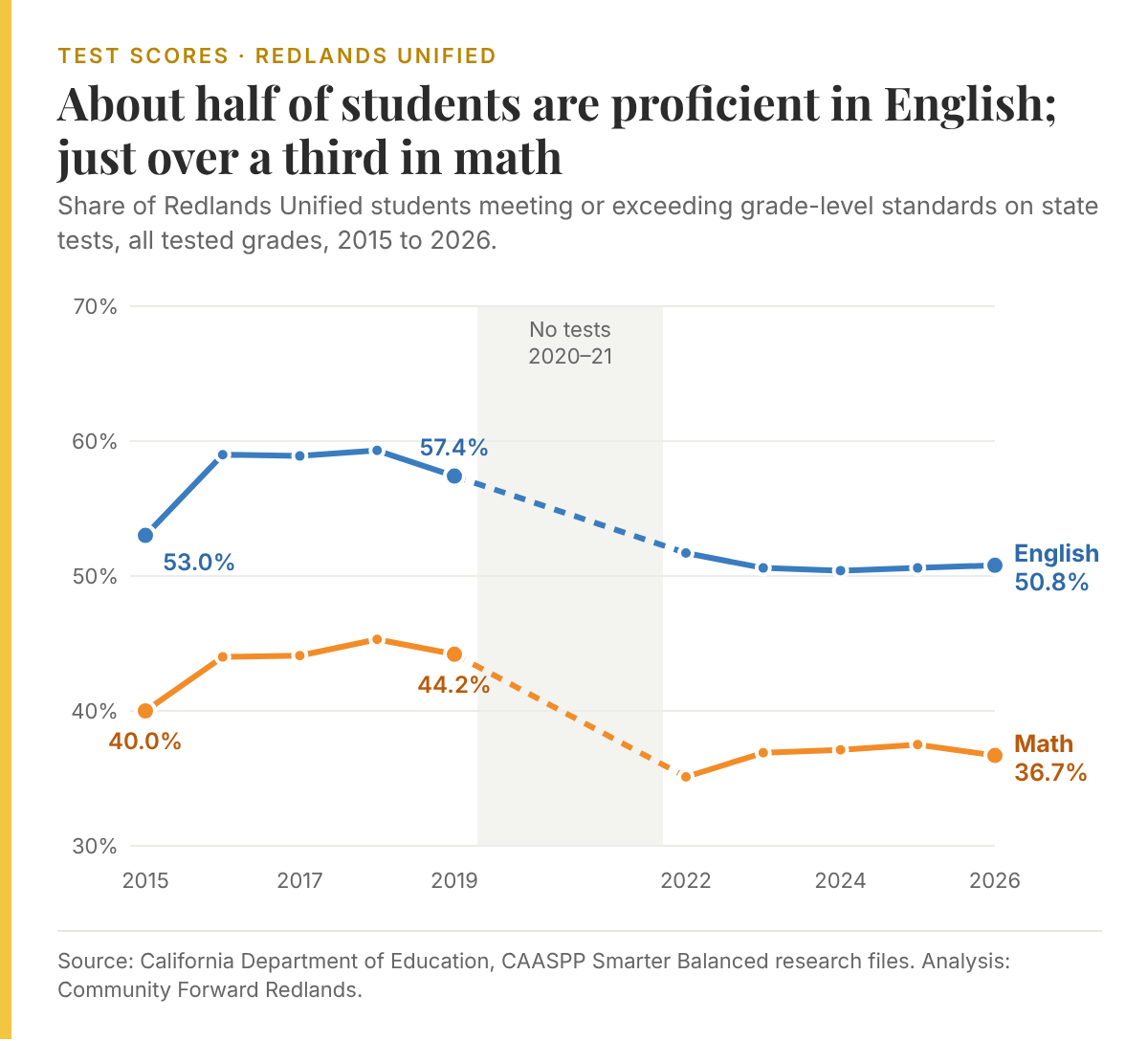
The results of the California Assessment of Student Performance and Progress (CAASPP), released Oct. 15, show that about half of students tested proficient or advanced in English language arts, while just over one-third did so in math.
Before the pandemic, 57.4% of Redlands students met or exceeded state standards in English and 44.2% did so in math. Those rates have yet to recover, with English proficiency at 50.8% and math at 36.7%.
Redlands Unified officials declined to comment on the results before a planned presentation to the school board Tuesday, Oct. 27.
The district was asked to explain what strategies it has implemented to improve performance and what may be contributing to gains at individual schools.
California renamed its achievement levels this year, replacing "Standard Met" and "Standard Exceeded" with "Proficient" and "Advanced." The scoring thresholds did not change, allowing comparisons across years.
Redlands falls behind state in math
While test scores across California have gradually improved since the pandemic, Redlands Unified has made less progress.
In 2019, Redlands outperformed the state in both English and math. Today, the district remains slightly ahead in English but has fallen behind in math.
Since testing resumed in 2022, California's math proficiency rate has increased 5 percentage points, compared with just 1.6 points in Redlands. English scores have also improved statewide while declining slightly in Redlands.
The district's latest results show little change from last year. English proficiency increased just 0.2 percentage points, while math declined 0.8 points.
The longer-term results show a striking reversal for Redlands Unified.
Between 2015 and 2019, the district improved in both English and math while consistently outperforming California. But following the pandemic, Redlands experienced a steeper decline in math and has recovered more slowly than the state.
The trend in Redlands differs from a broader national pattern. A May 2026 New York Times analysis of academic research found that student achievement had been declining across much of the country for years before the pandemic.
Redlands, however, was making gains before COVID-19 and the decline came after.
Economic gaps persist
The districtwide averages also mask substantial differences in achievement based on students' economic circumstances.
Students classified as socioeconomically disadvantaged, who account for about two-thirds of those tested, scored roughly 28 percentage points below their peers in both subjects.
California classifies students as socioeconomically disadvantaged if they qualify for free or reduced-price meals, have parents who did not graduate from high school, or meet certain other eligibility criteria, including participation in programs for migrant or homeless students.
In math, just 27% of economically disadvantaged students were proficient or advanced, compared with 55% of students outside that group. In English, the gap was similarly wide, with proficiency rates of 41% and 69%, respectively.
The gap is not unique to Redlands, but the district's recovery among socioeconomically disadvantaged students has lagged behind the state. Statewide, students in this group have returned to their 2019 proficiency levels in math. In Redlands, they remain 5.5 percentage points below pre-pandemic levels.
The share of tested students classified as socioeconomically disadvantaged has also increased, from about 60% in 2019 to 66% in 2026. While that shift may contribute to lower districtwide averages, proficiency rates have declined within both economic groups.
Some schools improve despite districtwide stagnation
Despite the district's largely stagnant results, several schools recorded substantial gains over the past two years.
Redlands East Valley High School improved nearly 10 percentage points in math and more than 6 points in English between 2024 and 2026. Economically disadvantaged students at the school posted similar or larger gains in both subjects.
McKinley and Kimberly elementary schools also improved in both subjects. Kimberly gained nearly 8 points in English and 7 in math, making it the district's highest-scoring elementary school in both subjects.
At Victoria Elementary, where approximately 92% of students are economically disadvantaged, English proficiency increased for two consecutive years, rising from 32.6% in 2024 to 40.3% in 2026.
Other schools moved in the opposite direction.
Redlands High School saw one of the largest declines, with math proficiency falling 10 percentage points and English dropping 6 points. Highland Grove and Judson & Brown elementary schools also experienced significant declines in math.
The results show that while some schools have made progress, those gains have not been enough to lift districtwide performance.
English learner progress and graduation rates improve
Not all of the district's academic indicators remained stagnant.
The share of English learners making progress toward English proficiency increased 4.1 percentage points to 53.8%, according to the California School Dashboard.
The district's graduation rate also increased, reaching 93.5%, about 5 percentage points above the statewide rate.
The district plans to present its analysis of the results at the Redlands Unified school board meeting Tuesday, Oct. 27.
Community Forward Redlands will examine elementary school trends, gender disparities in math achievement and the district's persistent chronic absenteeism in separate reports.
A former broadcast news producer, Stephanie launched CFR in 2023. Originally from Michigan, she’s made Redlands home with her husband and three kids. When she’s not reporting, she’s problem-solving at the climbing gym or trying new local restaurants.