


Redlands Unified seeks input on school spending plan
District survey open through March 11 will help shape how millions in state education funding are spent on programs and student support.

REDLANDS, Calif. — Redlands Unified School District is asking parents, students and community members to weigh in on how the district should spend millions of dollars on programs and services for students next year.
The feedback will help shape the district’s Local Control and Accountability Plan, or LCAP, a state-required document outlining priorities, programs and spending for public schools.
The district’s survey for the next LCAP cycle is open through March 11.
The plan plays a central role in how the district allocates funding and measures progress in areas such as academic achievement, student engagement and school climate.
What the LCAP does
California requires every school district to adopt an LCAP as part of the Local Control Funding Formula, the state’s primary system for funding public schools.
The law gives districts flexibility in how they spend state education funding but requires them to set goals and report how programs and spending will improve student outcomes.
The plan must also incorporate feedback from parents, students, teachers and community members.
Redlands Unified’s LCAP is part of a three-year planning cycle (2024 – 2027) with annual updates reflecting new data and community input.
District budget and funding
For the 2025–26 school year, Redlands Unified expects to receive about $337.8 million in revenue from state, federal and local sources.
Here’s how it breaks down:
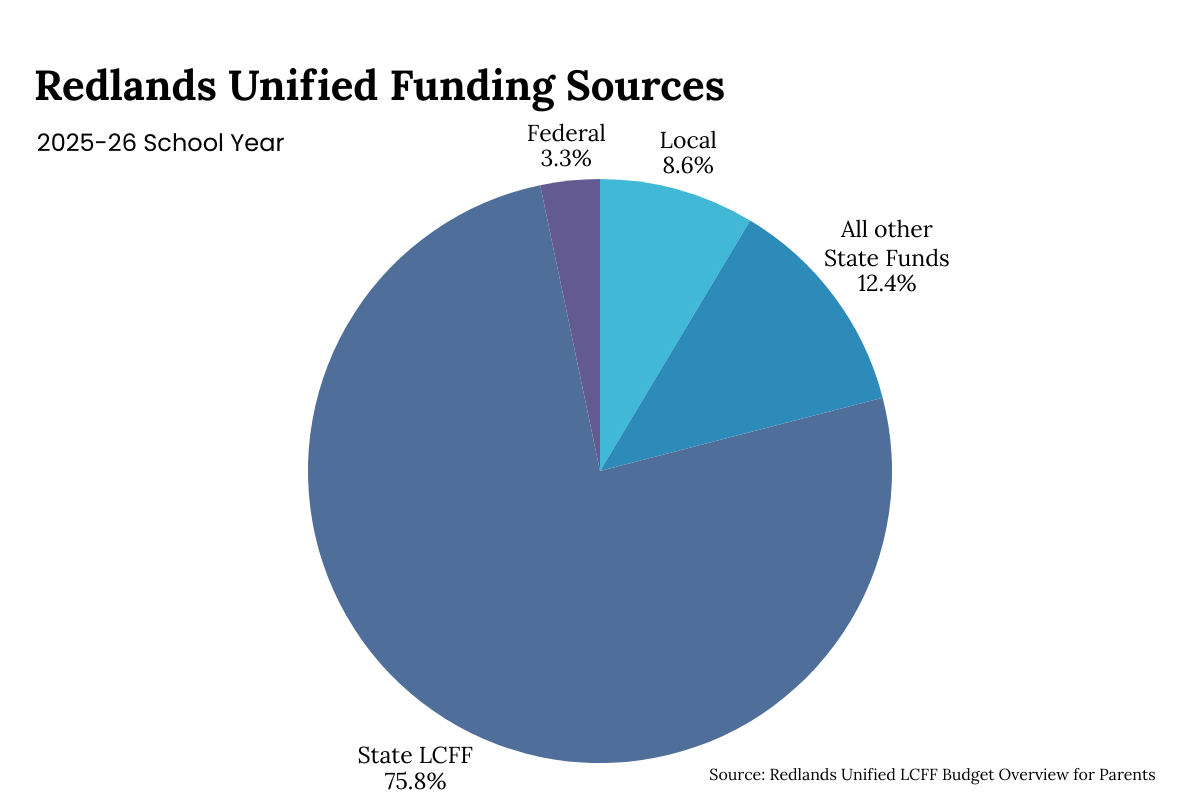
Most of the district’s funding comes from the state’s Local Control Funding Formula, which is calculated based on enrollment and average daily attendance (ADA).
Within that amount, about 13% ($43.4 million) is generated based on enrollment of “high-needs” students, including low-income students, English learners and foster youth. State law requires districts to use those funds to increase or improve services for those student groups.
Population of District
Redlands Unified serves about 19,770 students across 25 campuses, including 16 elementary schools, four middle schools and three comprehensive high schools.
The district’s student body is majority Hispanic or Latino at about 56.6%, followed by 20.3% White, 7.7% Asian, and 5.9% African American students, according to the 2025-26 LCAP.
About 8.5% of students are English learners, representing 56 different home languages.
District data also show that 66.4% of students are classified as “unduplicated” students — meaning they are low-income, English learners or foster youth — groups that generate additional state funding through California’s school funding formula.
The district also serves 1,065 students experiencing homelessness.
Key challenges identified by the district
The LCAP outlines several areas where the district says improvement is needed.
Among the most significant:
- Attendance rate improvement: The district’s average daily attendance rate is about 93%, down from roughly 95% before the COVID-19 pandemic. About 20.1% of students were chronically absent in 2024, meaning they missed at least 10% of the school year.
- Math performance: District leaders say math achievement remains an area of concern across grade levels.
- English learner progress: Some schools have struggled to improve outcomes for students learning English.
- College and career readiness: The district is working to increase graduation readiness, career technical education participation and college preparation.
Major goals of the plan
The plan outlines several strategies aimed at addressing those challenges.
One focuses on school climate and student support, including counseling, mental health services, behavioral programs and family engagement efforts.
Another goal targets academic progress, particularly in English language arts and mathematics, through tutoring, intervention programs and teacher training.
The plan also includes efforts to expand career technical education programs, arts education and extracurricular opportunities designed to increase student engagement.
Several programs are specifically aimed at supporting low-income students, English learners and foster youth.
Community input required
State law requires districts to consult with community members when developing the LCAP.
Redlands Unified gathers input through advisory committees, student groups and surveys. The district also conducts public meetings where the school board reviews data and community feedback before adopting the final plan.
The current community survey will help guide priorities for the next school year’s LCAP update.
District officials say feedback from families and residents helps determine which programs are maintained, expanded or changed.
Community members can access the survey and learn more about the LCAP on the district’s website.
