Stater Bros. Charities and Shoes That Fit distributed more than 550 pairs of athletic shoes to students at the Redlands school following a Southern California fundraising campaign.
Redlands Unified considers $26 million in state funding for student mental health, behavioral support
As elementary suspensions rise and counseling resources shrink, the district weighs a seven-year funding opportunity that has divided school board members over parental rights and state requirements.
Redlands Unified is considering a state funding program that could provide approximately $26.1 million over seven years to expand mental health and behavioral support at 15 schools. (File photo by: kali9)
Funding opportunity: Fifteen Redlands Unified schools could receive a combined $3.725 million annually, or approximately $26.1 million over seven years, through the California Community Schools Partnership Program.
Growing student needs: Elementary school suspensions doubled during the first 45 days of the school year, while the district faces increasing demand for mental health and behavioral support following staffing cuts.
Board divided: Despite the district's proposal to restore counseling and behavioral support, some trustees opposed the state program over concerns about parental rights and medical services that district officials said are not required or planned.
What's next: The district must opt in by Nov. 1 to preserve its funding opportunity. Five additional schools could qualify in January.
REDLANDS, Calif. — Redlands Unified School District could receive more than $26 million in state funding over seven years to expand mental health and behavioral support at 15 schools, as administrators report growing student needs and fewer staff available to address them.
District officials presented the California Community Schools Partnership Program to the Board of Education on Tuesday, Oct. 27, outlining how the funding could help restore counseling and behavioral support services following staffing cuts last spring.
The proposal drew mixed reactions from board members, with some welcoming the additional resources and others raising concerns about parental rights, school-based health services and requirements attached to the funding.
The district faces a Nov. 1 deadline to opt into the program.
What is the California Community Schools Partnership Program?
The program is designed to remove barriers to learning by coordinating academic, mental health, social and community services around four pillars: integrated student supports, family and community engagement, collaborative leadership and extended learning opportunities.
District administrators said Redlands Unified already addresses several of those areas through school site councils, family engagement initiatives and its Expanded Learning Opportunities Program, which provides after-school enrichment and academic support.
The district's proposed focus would be on mental health and behavioral services, including additional school counselors, behavior support specialists, registered behavior technicians and board-certified behavior analysts.
District reports growing behavioral and mental health needs
Administrators presented data showing rising behavioral challenges, particularly among elementary school students.
During the first 45 days of the current school year, elementary school suspensions doubled compared with the same period last year, while secondary school suspensions remained unchanged.
Elementary schools also accounted for more than 83% of reported workplace violence incidents involving students and staff. District officials cautioned that some of the increase reflects improved reporting procedures.
Mental health concerns remain significant. The district is on pace to receive approximately 800 intensive mental health referrals this school year, following reductions in counseling staff.
District officials also reported 19 suicide risk assessments involving elementary school students so far this year.
Marissa Butcher, the district's coordinator and behavior analyst, said fewer counselors may also mean fewer students are being identified for early intervention.
Administrators said the community schools funding could provide specialized staff to address those needs before behavioral problems escalate and interfere with classroom instruction.
Fifteen schools could receive funding
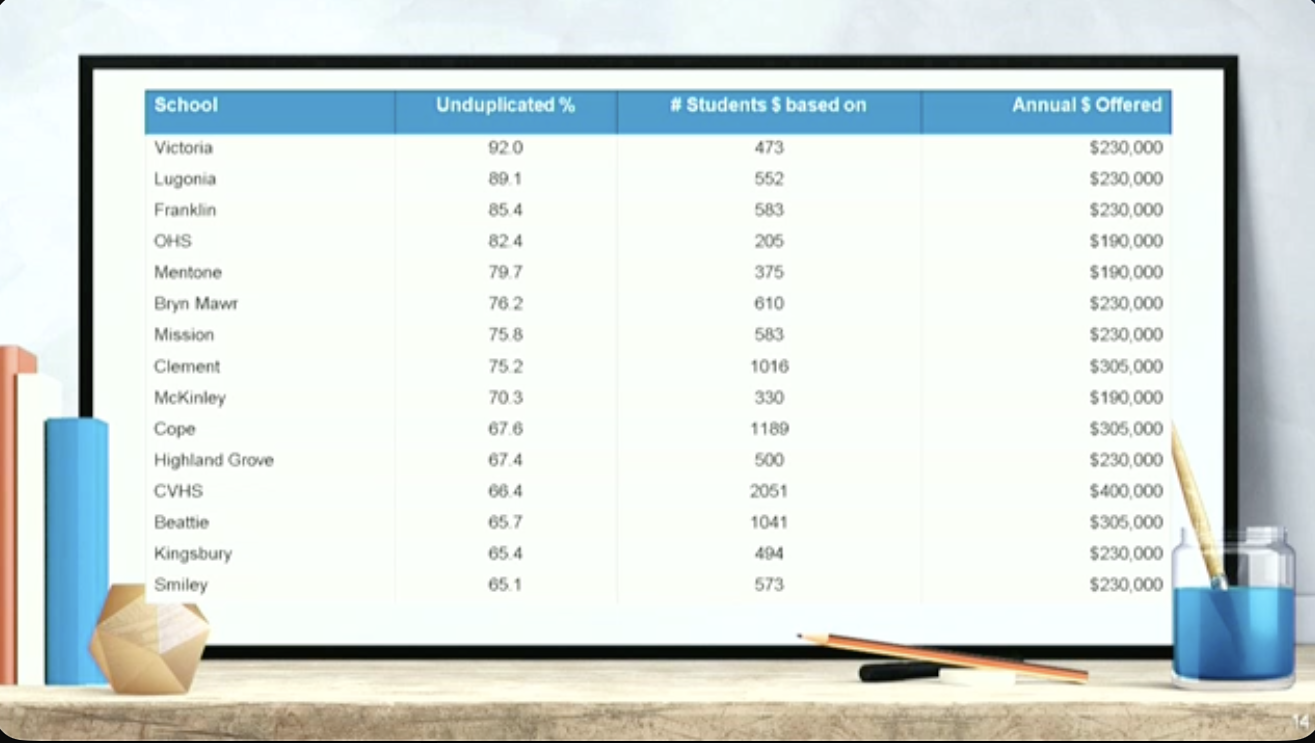
Fifteen Redlands Unified schools currently qualify for the program because at least 65% of their students are classified as unduplicated pupils — students who are low-income, English learners or foster youth. Students meeting more than one category are counted only once.
The eligible schools could receive a combined $3.725 million annually, or approximately $26.1 million over seven years, based on allocations presented by the district.
15 schools qualify for funding through the California Community Schools Partnership Program. Screen caption from presentation by district officials on Oct. 27, 2026.
Individual school allocations range from $190,000 to $400,000 annually. Citrus Valley High School would receive the largest amount, while Victoria Elementary has the highest concentration of qualifying students, at 92%.
Five additional schools are expected to qualify when updated enrollment and demographic data are certified in January, potentially expanding participation to 20 of the district's 26 schools.
The funding would be available for up to seven years, including a planning period of up to two years. Participating schools must complete needs assessments, involve parents and community partners in decision-making, develop comprehensive plans and demonstrate how the funding improves student outcomes.
District officials recommended entering the planning phase, which would allow schools to begin developing plans and hiring support personnel while receiving funding.
Board divided over funding requirements
Board member Jeannette Wilson was the first to question the proposal, asking how the funding would support academic goals, whether the district could concentrate spending on behavioral services and how it would sustain new positions after seven years.
Superintendent Juan Cabral said funding like this typically comes in two- to three-year windows, which is less sustainable.
"Seven years does give you the opportunity to really plan ahead," Cabral said.
District officials also explained that the community schools program is funded through Proposition 98, California's constitutional school funding guarantee. The money is part of the state's existing education funding allocation rather than an entirely separate source of revenue.
Board President Michele Rendler also expressed reservations about the broader community schools model.
"I'm not for Community Schools [Partnership Program] in any way," Rendler said. "I think parents need more — I don't know, they need to do more and be more involved."
Rendler said she could support additional behavioral resources if the district could guarantee the money would not require medical clinics or immunization services on school campuses.
Board member Candy Olson voiced stronger opposition, arguing the program could expand schools' roles in decisions she believes should remain with parents.
"I'm 100% against community schools ideologically because I believe that the parents own their children," Olson said.
She acknowledged the district's need for additional resources but described accepting the money as "dancing with the devil."
Olson raised concerns about parental consent, student privacy, insurance billing through California's Children and Youth Behavioral Health Initiative (CYBHI) and whether program requirements could affect student discipline or school-level curriculum decisions.
Cabral said Redlands Unified has no plans to operate school-based medical clinics and that the program does not require them. He said schools can meet health-related requirements through referrals to outside providers, as the district already does.
He also said participation would not require CYBHI insurance billing or prevent the district from suspending students when warranted. He agreed to review the Education Code provisions Olson cited and provide additional clarification.
Cabral said the program would also require parents to participate in developing school-level plans.
"If anything, it gives parents more voice than they have currently," Cabral said.
Board member Ayala Quintero acknowledged the uncertainty surrounding the program but said the district's current needs warranted moving forward.
"The reality of the situation is our students need help right now," Quintero said. "We're dealing with more behavioral and emotional issues than our staff is able to handle. This is impacting every student."
Vice President Patty Holohan focused on the potential to restore counselors and behavioral support personnel, pointing to student disciplinary cases addressed at the meeting.
Public comments reflected similar divisions, with some residents expressing concerns about parental authority and local control, while others supported the program as a way to improve student safety and access to services.
The potential funding comes months after Redlands Unified approved layoffs affecting 24 certificated employees, including 17 counselors, as the district worked to address its budget deficit.
Cabral said the district is considering the program now because more schools qualify than in previous years and student needs have continued to increase despite declining enrollment.
"We have less students and more need," Cabral said.
"We're not trying to parent them," he added. "We're trying to make sure that when they come to school we can provide what they need so that they can focus on school."
Cabral said the seven-year funding period could allow the district to expand support while stabilizing its finances, although the district would need to plan for the possibility that the funding could eventually change or end.
What's next?
Superintendent Juan Cabral said he would opt into the California Community Schools Partnership Program by the Nov. 1 deadline, preserving the district's opportunity to receive funding for 15 eligible schools.
Cabral brought the proposal to the Board of Education on Oct. 27 to gather feedback, although board approval is not required for the district to opt in. The board did not take a formal vote.
Cabral emphasized that opting in does not commit the district to spending the money. Specific spending plans and staffing proposals would return to the board for approval.
If the district moves forward, schools would begin needs assessments and planning, with funding expected to arrive shortly after winter break during the 2026-27 school year.
A former broadcast news producer, Stephanie launched CFR in 2023. Originally from Michigan, she’s made Redlands home with her husband and three kids. When she’s not reporting, she’s problem-solving at the climbing gym or trying new local restaurants.